The Rod Club
Hot tips, local lore, camaraderie, and the heady aroma of pipe tobacco — these are a few of my favorite things.

IN A DISPLAY case on the wall at my fly fishing club, there’s a poster-sized color photograph of a gentleman in his sixties or early seventies holding a fly rod in one hand and a wading staff in the other. He’s wearing a Mona Lisa smile and a stained white safari hat with the brim on one side snapped up at a rakish angle.
I had no idea who he was until I met the man who identified his body for the coroner.
Ron Montecalvo died with his boots on. He was wading the Narrow River, a tidal marshland that dumps into Rhode Island’s Narragansett Bay, for striped bass when he suffered a massive heart attack and tumbled into the surf. No one knows for sure whether he was already gone when he hit the water or drowned, but when his body floated past, a couple of spin fishermen pulled him ashore.
Dennis Pelletier, a fellow member of our club, Rhody Fly Rodders, showed up to prospect the Narrow’s productive pools just as Ron was being dragged ashore, and IDed the body for the medical examiner. Dennis tells me he knew instantly it was Ron by that trademark hat. He retrieved Ron’s gear and, almost as an afterthought, clipped off the fly Ron was fishing. Years later, during the “any other business” section of one of our meetings, a choked-up Dennis held up the fly — a black, silver and tan streamer of indeterminate pattern now mounted on a rectangle of adhesive foam core — and ceremoniously stuck it in the upper left corner of Ron’s photo. A fisherman and his final fly, reunited for posterity at the very club where Ron was a founding member. Nice.
Nice, because all of this isn’t anywhere as morbid as it sounds. Ron was a few months shy of eighty; he’d lived a full, successful, and satisfying life; and he passed while doing the very thing he loved the most on one of his favorite fishing holes — a spot that not too long ago gave up a fifty-eight-pounder. Let’s face it: It’s precisely the kind of death many of us fantasize about.
And this is exactly the kind of local lore you’ll come across only at a fishing club.
___
SOLITUDE IS generally underrated in fly fishing and most other human pursuits, but even though some of us have the social proclivities of the Unabomber, there are times when it makes sense for tiers of feathers to flock together. Enter the rod club, a place to forge angling friendships, trade tips, and otherwise huddle up.
A good club welcomes grizzled veterans and bright-eyed beginners equally; in other words, it’s not elitist. It also spends a good chunk of its time and resources on stream conservation. Every fly fisherman worthy of the name is at least a closet environmentalist for obvious reasons that can appear purely selfish, and maybe we are. With any luck, you had a dad like mine who’d stuff snarled monofilament, beer cans and other litter into the zippered back compartment of his vest. Dad’s mantra — Leave the lake or river cleaner than you found it — has become my own, and now it’s one I’ve been teaching my grandsons. Never mind the irony of my father’s fastidiousness: The crowning achievement of his engineering career was designing a key component on the Lunar Rover used by successive Apollo missions to collect soil samples, and his work now litters the moon.
A club should also actively find ways to give back. That can look differently for each club, but teaching kids — especially troubled ones — how to fish is never time wasted. Neither is organizing a canned goods drive for the local food pantry, or tying flies to be auctioned off to raise money for anglers battling cancer. I guess what I’m trying to say is that ideally, a fishing group should look outward as much as inward, doing what it can to grow the sport and sow a little goodness in the world. Just because many of us are antisocial doesn’t mean we can’t do our part for society at large.
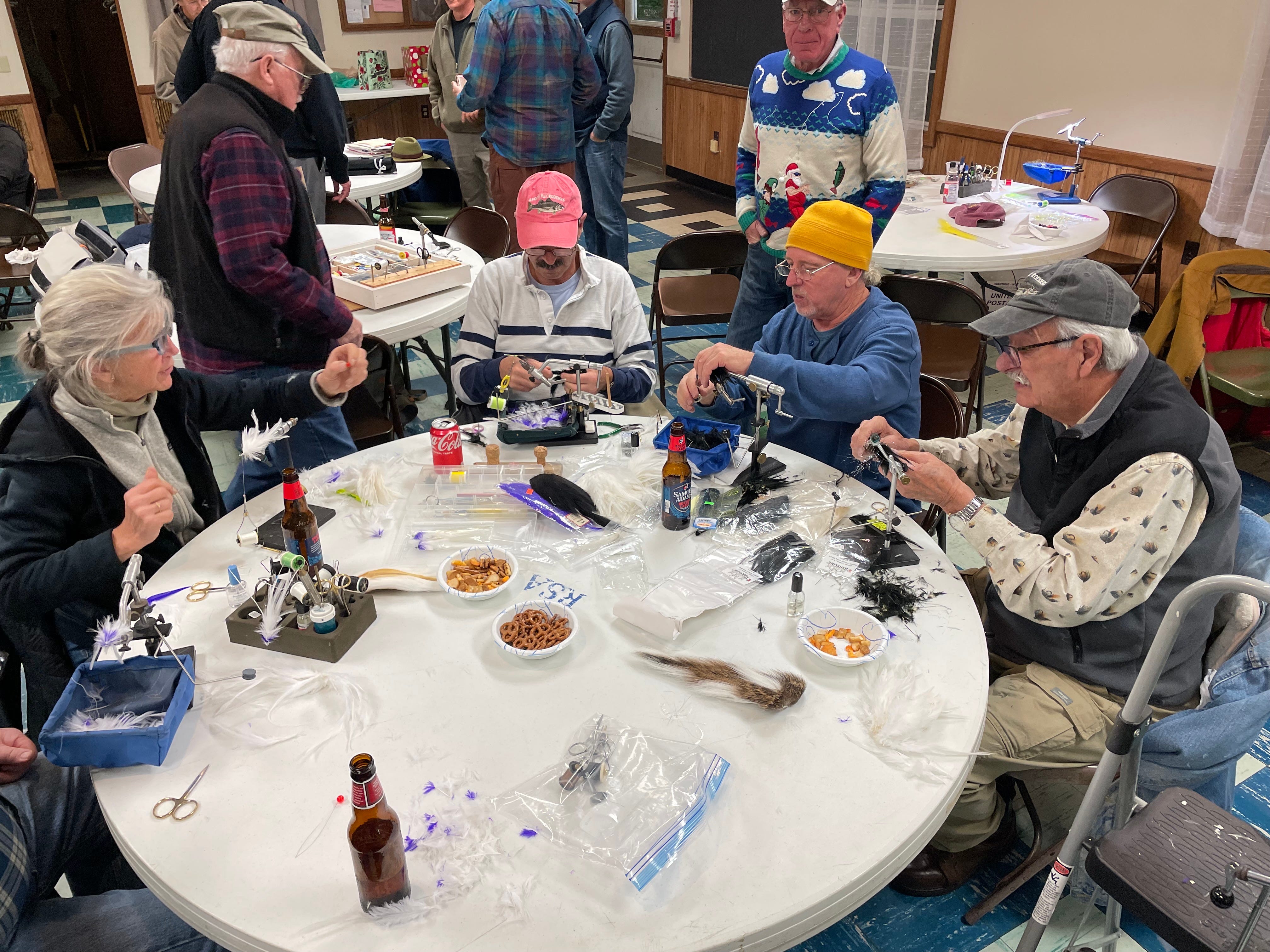
Rhody Fly Rodders does all of those things. Mostly, though, we gather on the third Tuesday of each month in a low, squat, wood-paneled building owned by the Riverside Sportsman’s Association to tie flies, regale one another with tales of fish caught and lost, and share the latest intel on hidden honey holes for striped bass, bluefish, and other quarry around Greenwich and Narragansett Bays. This is a bigger deal than you might think and requires both generosity on the part of the night’s speaker as well as discretion for those of us listening. Anglers are notoriously tight-lipped about what little we think we know about productive places to fish, so divulging information doesn’t come naturally. On paper, Rhody’s rule is selflessly idealistic: Pass on to all who ask what you learn here. But that rubs up against anglers’ natural tendency to guard a hot tip like it’s a gold bar at Fort Knox.
There’s an unwritten code — maybe it’s actually written somewhere; I haven’t read the club’s bylaws — that if you’re entrusted with a tip, you don’t turn around and post it on social media. In my club, this is known as “spot burn,” and it is angling’s equivalent of the unpardonable sin. Kiss and tell isn’t just frowned upon in fly fishing: It can get you ostracized, and if that happens, you have only yourself to blame.
If you betray a confidence at Rhody, you can theoretically drown your sorrows at the club bar, although the bartender pours far more soda than scotch. We’re men and women of a certain age, and many of us are at a point where we’re trying to undo a lifetime’s worth of damage. You know how it is — and if you don’t, trust me, you will someday.
Rhody Fly Rodders, America’s oldest saltwater fly fishing club, was established in 1963, and for a long time I thought that was a typo. This is, after all, New England, and to be the oldest anything here usually requires a pedigree dating at least to the nineteenth century, if not much earlier. 1863 or 1763 would be entirely plausible, and not even 1663 would have surprised me. For a decade, I lived and fished on Cape Cod Bay just a few miles down the coastline from Plymouth, Massachusetts, where the Pilgrims waded ashore in 1620. Surely some of those newcomers who’d boarded the Mayflower with their funny buckled hats knew of Izaak Walton, the English writer who authored The Compleat Angler in the mid-1600s. Yet Rhody Fly Rodders didn’t debut until more than three centuries later. (The oldest angling club of any kind in the US is the Schuylkill Fishing Company, founded in Philadelphia in 1732. According to the International Game Fish Association, it remains the oldest continuously operating social club in the English-speaking world.)
The Pilgrims didn’t fly fish — the sport wouldn’t really catch on in this country until the early 1800s, with its cradle in the Catskills — but they probably caught and ate more trout than turkey. The Wampanoag, the Indigenous people who befriended the Europeans and helped them survive those first few brutal winters, were known to fish for native brook trout and would have shared their techniques. I can’t help but think, though, that tribal leaders like Massasoit held back for themselves a few of their most productive spots for brookies.
Anglers, after all, are anglers whether they’re wearing deerskin or dungarees.
___
FISHING CLUBS have become part of my genetic wiring; as much a component of my sportsman’s DNA as my penchant for bamboo fly rods and dry flies — both hereditary traits passed straight to me by my father.
In the 1960s and ‘70s, Dad was a member of two national fly fishing organizations with chapters in Massachusetts — Trout Unlimited and United Fly Tyers — and as the eldest of his three sons, I got to tag along. I have vivid memories of drinking five-cent bottles of Coca Cola chilled in the Coke-branded red fridge in the corner as the men smoked, tied the latest hot fly and told off-color jokes, lowering their voices conspiratorially if I happened to wander near. Occasionally the men (there were no women that I can recall) would convene on a Saturday morning at a river to shore up collapsing banks with logs, root wads, and other natural materials. This, of course, was always done in the offseason so as not to interfere with anyone’s fishing. Without fail it would be a teeth-chatteringly cold day, overcast with tiny beads of graupel pelting us, and I have a vague memory of a stainless steel flask being passed around to give the grown-ups an illusion of warmth.
It was at a UFT meeting that I tied my first fly. The precise pattern is lost to the sands of time, yet I vividly remember the gentle words of encouragement and thumbs up from the club’s older gents. I’d tied in oversized, cockeyed wings, way too much dubbing for the body, and easily half a dozen turns too many of hackle. This was a fly that could choke a horse, but my elders knew that I knew that and instead celebrated the achievement, knowing I’d tie thousands more and slowly improve. I guess I did, though the rejects I’m still tossing into a plastic soup container sometimes make me wonder.
It’s funny, the things that imprint on you in your youth, charting a life’s course or at least nudging you in a certain direction. For me it was pipe tobacco, the smooth texture of varnished split cane, and the wonder of seeing a trout fly take shape on a bare hook clamped in a vise. All of that and more I experienced at a rod club, which explains why I’ll always feel immediately at home even at a new one.
The ‘70s were a golden era when fly fishing, tying, and rod building were all booming in the US — a time when the heroes of the sport, much like Cher or Madonna, were known widely by one name: Lee (Wulff), Lefty (Kreh), Art (Flick), Vince (Marinaro), Joan (Wulff). Fun fact: Dad went to high school in North Haledon, New Jersey, with Joan back in the 1940s when she was Joan Salvato and told me she was every bit a hotshot tournament caster even as a teenager. She and Lee became American fly fishing’s first couple, and she helped found the Catskills Fly Fishing Center and Museum.
Here in Rhode Island, we’ve got Ray, our own contribution to fly angling royalty. Capt. Ray Stachelek, the president of Rhody Fly Rodders, is a retired teacher with sixty-plus years of experience fly fishing for striped bass, bluefish, and other saltwater species. He’s also an innovative tier of national prominence and a frequent presenter at fly fishing shows up and down the East Coast. And he’s a mensch — a personable charter captain who’s endeared himself to generations of fly anglers, partly because of his disarming way of lacing conversation with jokes and ending almost every sentence with “and stuff like that.”
Rod club histories are fascinating because they inevitably reference legendary anglers of decades past — men and women like Ron Montecalvo who are no longer with us, but whose exploits and fishing prowess make you wish you’d known them and wet a line with them. Rhody was founded in a basement by two such individuals: Harold Gibbs, a former state director of fish and game in Rhode Island who developed the Gibbs Striper Fly, one of the first streamers for striped bass; and Al Brewster, a saltwater fly fishing pioneer and freight train conductor who was said to have the girth and stature of a grizzly bear and was married to a petite woman nicknamed Butch.
Brewster died in 2013 at age 96, leaving a legacy that captures the imagination. In a 2004 tribute, former commercial fisherman Molly Benjamin wrote of his innovations: “He was among the first to develop the notion of fly-fishing in saltwater, back when there was nothing ready-made available. Al and his buddies almost literally got stuff out of garbage cans that they later turned into big, wondrous saltwater flies. The lines weren't really the right kind and rods had to be made to handle the bigger stuff. It was pretty much a do-it-yourself fishery at the time. … After a while, Al and his friends actually began to catch fish on their whacked-together rigs.”
Another local fly fisherman, the late Armand Courchaine, said Brewster was like a father to him and recalls the first time he stepped into Al’s basement for the first meeting of Rhody Fly Rodders in 1963. “Entering the basement, I couldn’t believe what I was seeing,” Courchaine wrote. “He had a long row of tables with five fly-tying vises. I ask, ‘How come so many vises?’ His answer: ‘A vise for tying dry flies, another for streamers, wets, bass bugs and saltwater.’ I learned he was a commercial fly tyer for Orvis, LL Bean, Corcoran’s. He had boxes with jungle cock, bucktails, feathers — you name it, he had it. [Plus] I don’t know how many bamboo rods and a pipe collection. I thought I was in the Disneyland of fly tying and fishing.”
I don’t know about you, but snippets like these make me feel like I was born in the wrong era. While everyone else is obsessing over the latest hotshot celebrity angler, I find myself drawn to yesteryear’s heroes.
___
ROD CLUBS can get a little gonzo.
One I’ve been meaning to visit is the Striped Bass Fishing Night Club, a group of Rhode Island saltwater anglers who bond over their shared passion for heading out on pitch-black, moonless nights, when the bite can be fleeting but sensational when it comes off. “Hot striped bass action in the VIP lounge,” the club’s Google page promises.
A friend once told me about a club in the Pacific Northwest that calls itself The Prevaricators and insists that size, at least in fishing, doesn’t matter, which is true enough. Its Facebook page describes it as “a unique fishing club that understands most men fish their entire lives without knowing that it’s not really the fish that they are after.” As if to prove its point, the club has its own dictionary-style definition of prevarication:
Prevarication — \pri-ˈver-ə-ˌkāt, -ˈva-rə-\: to deviate from the truth — especially when speaking of past accomplishments while fishing.
Example of prevarication:
“How was the fishing today, CJ?” ... “Great! I caught a 24-pound silver!” [obvious prevarication]
You’ll find rod clubs in unlikely places like Manhattan, where Trout Unlimited’s New York City chapter is headquartered. It may seem bizarre to imagine fly anglers in a city better known for the morning rush hour than the morning rise, but by all accounts, TU is thriving in Gotham. The club teaches newbies how to fly fish for lunker carp in the nine ponds that dot Central Park — one of its events is called “Big Fish in the Big Apple” — and it even has a licensed resident guide. Dr. Brandon Dale, a physician who advertises himself as “the only fly fishing guide working Manhattan waters,” says he works with clients who range from investment bankers to Uber drivers.
Admittedly, this isn’t exactly highbrow angling. In an article for the online outdoors outlet Field Mag, Bob Myaing describes bringing one of New York City’s big carp to hand: “Hoisting the fat fish out of the net for a photo, it was hard to ignore the pungency of its odor. Yes, all fish smell, but boy, do carp stink on a whole new level. Add in some generally gnarly NYC lake water and you've got one nasty cocktail.”
You’ll also occasionally run across rod clubs with whimsical names like Bait & Switch, Reel Cool, Knot Again, Troutrageous, Bonefish Boneheads, and Catch Me If You Can. A favorite is a club in Colorado that calls itself the High Plains Drifters. Clubs that sponsor tournament events wind up fielding teams with monikers that mother wouldn’t approve, like the Master Baiters or the Thundersticks.
A good club is accommodating, but human nature being what it is, there’s no shortage of private, members-only clubs that embrace exclusivity and offer the finest fly fishing money can buy. These are angling’s answer to the American Express platinum card, and if you’re willing to part with a couple of grand a year — sometimes much more than that — your special-issue ID badge will grant you “superior fishing access” to privately owned sections of a stream with an improbable number of twenty-inch trout. One of these clubs, a self-described “hidden gem in the Poconos,” has a five-year waiting list, and just to get on the list requires a recommendation from a current member in good standing. It’s not my jam, and I probably couldn’t afford it even if it were, but clearly, membership has its privileges.
___
OTHER CLUBS are doing their level best to redefine what it means to be the best versions of ourselves.
Clubs that cater to women are fueling explosive growth in a sport that’s long been dominated by men, and it’s long overdue, considering the impact of generations of women like Mary Orvis Marbury, Joan Wulff, Jen Ripple and others. I’m thinking of Juliana’s Anglers in New York, named for Dame Juliana Berners, a 15th-century English noble and fervent outdoorswoman who in 1496 wrote A Treatyse of Fysshynge wyth an Angle, the earliest known essay on fly fishing. There’s also Spokane Women on the Fly in Washington state, Oregon’s Stonefly Maidens, Flygirls of Michigan, and dozens of others. And though it’s more of a program than a club, there’s Casting for Recovery in Vermont, which provides free fly fishing retreats for women with breast cancer. It doesn’t get much more inspiring than that.
If I have a beef with contemporary fly fishing clubs, it’s their relative lack of diversity. Step inside most rod clubs, including my own, and you’ll find yourself surrounded by white males. It’s rare to run into an angler of color, and if nothing else, that’s a shame. Surveys show that three in four fly anglers are white, and the vast majority of those are men in their fifties with a household income of around $150,000 a year. I don’t know about you, but I find it incredibly refreshing to see groups like Brown Folks Fishing partnering with industry giants like Orvis to make our sport more inclusive.
___
BACK AT Rhody Fly Rodders, the club with the solemn vow — Pass on to all who ask what you learn here — Ed Lombardo is wrapping up a detailed presentation on some of the state’s hottest spots for striped bass. Ed’s slideshow is replete with photos of him cradling forty-inch-plus bass taken from places few of us ever would have thought to cast, and we’re all sitting a little straighter in our seats. A few of us are furiously scribbling notes, and I’m furtively taking photos of his projected slides with my iPhone, trying to act natural.
It’s a virtuous act of generosity. After all, Ed makes his bread guiding anglers around Rhode Island’s salt, and he’s got zero to gain and everything to lose by sharing his trade secrets for free.
But like a card shark in Las Vegas, even Ed, the dean of Northeast saltwater fly fishing, has a tell. His last slide coyly depicts a rod with the fly hidden within a white envelope, and Ed says he always has a supply of envelopes so he can conceal a hot tie from the prying eyes of mixed company.
He smirks as he says it, and I still can’t quite work out whether he’s serious or joking. If I had to guess, though, I’d go with secrecy and discretion. Now in my seventh decade, I’ve seen a lot, but I’ve never spotted a billboard on the interstate advertising a hotspot.