The Fish Tank
“9-BLUB-BLUB: Please state your emergency.” . . . . . “Help! My tropical fish are murdering each other!” And with that, the hunt is on for a poisson of interest.

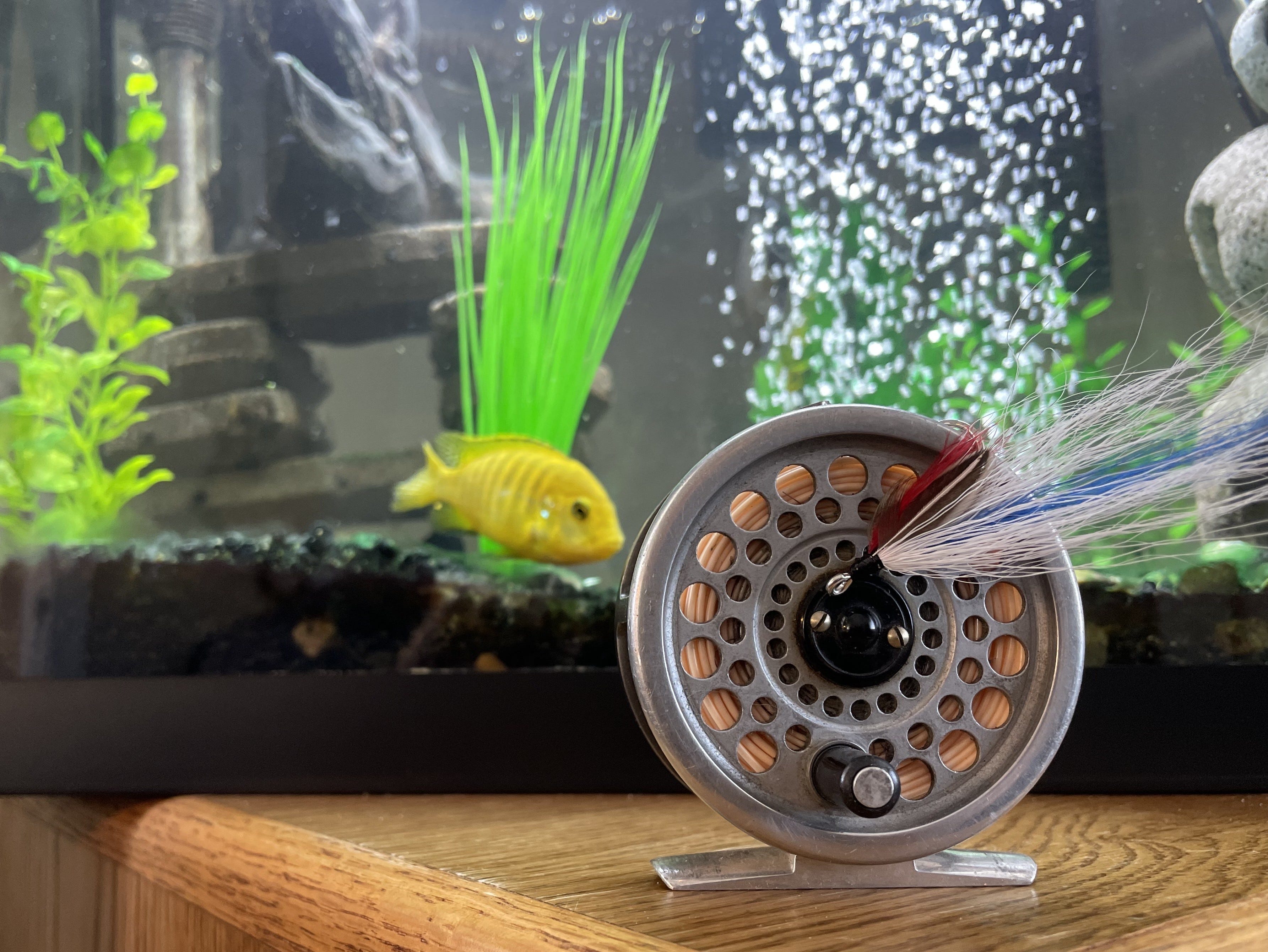
“ANYBODY HAVE a pet muskie?”
That headline on a discussion thread on an online forum devoted to the pursuit of muskellunge, a prehistoric predatory fish that prowls the Upper Midwest and can grow to monstrous size, certainly got my attention. The only muskie I ever caught — barely, considering it nearly bit through a wire shock tippet — taped out at thirty inches and weighed eleven pounds, and my companions shrugged it off as a baby. Muskies can easily go three times that size — not exactly what I’d consider pet material. The care and feeding of a piranha might be easier.
But a guy calling himself Baldy said he wanted to keep one in an aquarium, and he had questions: How fast would it outgrow the tank? How often should he feed it? What’s the optimal water temperature? Baldy’s peers chimed in with advice that made it clear this was actually a thing, right down to specifics: A four-inch muskie, one guy warned, will outgrow a seventy-five-gallon tank in six months. Another with the username Slamr said a guy could find baby muskies and pike at pet stores in the Chicago area in May and June. Good to know.
In the end, though, I couldn’t muster the courage to tame a fish that can grow longer than my leg, snack on adolescent swans, and snap a nine-weight fly rod in two. So when I got bitten by the aquarium bug, I decided instead to keep far smaller and supposedly sedate African cichlids, along with a pair of juvenile bluegills purely for shits and giggles.
What I soon learned to my horror is that these pretty little tropical fish are no less homicidal.
___
I HAVE a confession: I’m a voyeur, a peeping Tom. I like to watch.
No, not like that, for Christ’s sake. Don’t be a perv. My obsession is my fish tank — a singular diversion that’s more entertaining than most human conversation, more engaging than Netflix, and cheaper than cable.
It’s also a welcome distraction when I can’t actually fish. There’s probably something slightly Freudian there, but whatever — I’m drawn to my finned friends. My grandfather used to joke, “Work fascinates me — I could watch it for hours,” and for me, it’s an aquarium.
During fly fishing’s offseason, most of us just want to get a good look at something — anything — with fins.
This is the kind of spontaneous act a fly angler in winter will undertake. Pretty much only the ice fishermen are out; a combination of cabin fever and opiate-like withdrawals is kicking in hard; and most of us have to content ourselves with flipping through gear catalogs and tying flies for the forthcoming season, which won’t begin until spring thaws enough open water to cast to.
The fly fishing humorist John Gierach called this restless, self-imposed exile the “shack nasties,” and it explains why a fair number of anglers are aquarists. I’ve met a few who grow caddis, mayflies, and other aquatic insects of interest in their tanks to study their appearance and movements, but most of us just want to get a good look at something — anything — with fins that’s swimming around.
For years, my late brother and erstwhile fishing partner, Brian, kept a tank populated entirely with native critters taken from the suburban Boston lake where we grew up fishing for bass, pickerel, and panfish. At regular intervals, the majority in Brian’s aquarium — not unlike Congress’s — would flip from fish to amphibians to reptiles. Usually this happened organically: He’d introduce one species too many, and within days, if not hours, his entire bespoke biosphere would go all Lord of the Flies on him. (On one occasion, Brian dropped a four-inch fingerling bass into the mix; less than a week later, the baby largemouth had the tank all to itself, having devoured every last tadpole, frog, teeny county fair turtle, and adolescent garter snake, along with half of the decorative vegetation.)
With apologies to those hysterical newsreels of the World War II-era zeppelin Hindenburg crashing and burning: Oh, the fishmanity. Which brings us back to the scene of the crime in my own fish tank.
___
“9-BLUB-BLUB: Please state your emergency.”
“Help! My tropical fish are murdering each other!”
The poisson of interest: Jack, our unimaginative name for my tank’s first occupant: a three-inch, black and purple Jack Dempsey cichlid. The species is named for the eponymous Depression-era American champion heavyweight boxer, and I’d soon learn why. My Jack, like that Jack, didn’t take shit from anyone.
Jack was a looker, sleek and luminous, but he was also a douche and a bully. As I introduced other fish into the aquarium, he’d swim right over and do the pescatarian version of shoving them into a locker and stealing their lunch money. For a while, I tried keeping a cichlids-only tank — an inelegant attempt at keeping the peace that smacked vaguely of ethnic cleansing — but Jack would rough up his own kind, too. I upgraded to a twenty-gallon tank on the theory that doubling Jack’s living space would improve his chill. I was wrong.
The bigger tank came with a different type of filter that Al, our small algae eater, couldn’t hide in. On what would be the last day of his little life, one of my grandsons renamed that fish Sucky — and the new name prophesied his miserable end: The insatiable Jack, now with a hunger for flesh like a cannibalistic serial killer, ate him. I found myself wondering if I should rename Jack. Maybe Hannibal.
Pro Tip No. 1: Don’t needlessly endear yourself to your aquarium creatures by giving them names. Pro Tip No. 2: A fish lying motionless on its side is never a good thing.
I’d wanted to add a crayfish, but feared the freshwater crustacean would make a meal of my fish. I needn’t have worried. With Jack in the mix, it was only a matter of time until I witnessed the aquatic equivalent of “Man bites dog,” with Jack tearing Tango — the tropical tangerine lobster I’d introduced to add color and interest to the tank — to pieces.
[Pro Tip No. 1: Don’t needlessly endear yourself to your aquarium creatures by giving them names.] It makes their inevitable burial at sea — the euphemism for flushing their remains down the toilet — immeasurably more traumatic. Take, for example, one of my sentimental favorites: Ruby, a red peacock cichlid. The other day, I found her lying motionless on her side inside her favorite hiding place, a hollow stone with three entry portals. [Pro Tip No. 2: A fish lying motionless on its side is never a good thing.]
I’d have dusted for fingerprints except, you know, water.
___
JACK DIED on the vernal equinox: March 20, midway through a painful divorce — mine, not Jack’s.
My ex had asked me to remove the tank from the home we’d shared, and naturally, I complied. Jack hadn’t been doing too well. I was confident he’d be fine — you don’t know Jack — but in the end, being placed in solitary confinement in a large, water-filled Ziplock bag before being stuffed in the trunk of a car for transport across state lines did him in.
It was, perhaps, a fitting end for a gangster.
If anyone asks about his whereabouts, my first inclination will be to respect omerta, the Mafia code of silence and honor made infamous in my late grandfather’s native Sicily, and plead the Fifth. More likely than not, though, I’ll blurt out the truth:
Jack sleeps with the fishes.