Showoffs
We distill into distorted funhouse mirror reflections of ourselves at a fishing show.

IN THE REAR of the convention center, a crowd has gathered around a flotilla of brawny bass boats painted in metal flake with twin engines sporting propellers the size of my thighs. These motors have serious muscle, if questionable stealth: You’d have to cut the power halfway across the lake or bay to have any hope of sneaking up on a fish.
It’s not the only kind of thrust on display at the New England Saltwater Fishing Show. Spray-tanned models in tight-fitting tank tops and gaudy sleeve tattoos twerk and flirt with the patrons packing the floor. Over in a corner, a guy is doing some brisk business selling MAGA-style ‘Merica merch.
And the jerky? Oh my God, so much jerky. Nearly every aisle has a jerky vendor catering to every imaginable taste, including cured alligator and kangaroo and something extra-spicy called Chernobyl Beef Jerky, packaged none too subtly with a nuclear fireball and mushroom cloud on the label. I secretly want to try some but worry I’ll nuke my taste buds.
As I wander the booths, I find myself in sensory overload and wondering: When did fishing shows start looking more like monster truck rallies? The only missing element is an announcer bellowing into the PA system: “LADIES AND GENTLEMEN, LET’S GET RRRRRREADY TO RRRRRRUMBLE!”
___
IT SEEMS like it was just a couple of decades ago when fishing expos were fairly straightforward affairs where the tackle, not the tease, was front and center. Fly fishing shows, a subset of the genre, were even more sedate: The flashiest they’d get would be to bring in a celebrity angler like Lefty Kreh or Joan Wulff, who’d demonstrate the kind of precision casting skills most of us could only dream of acquiring. Media coverage was either nonexistent or, even at a bigger national show, limited to Fly Fisherman magazine. There’d be a few fly tying demos projected on a big screen, and rodmakers would talk tapers, line weights and loading with weekend duffers. If there was such a thing as trout porn, that was pretty much it: G-rated foreplay for dorks like me.
As a pre-teen at one of those no-nonsense, stripped-down fly fishing shows in Boston in the early 1970s, I won an electronic fish finder in a raffle. This was an odd prize considering the clientele — fly anglers have little use for gadgetry like that, analog or digital — but in 1972, it retailed for a hundred dollars, the equivalent of eight hundred bucks today. My father sold it on my behalf to a bass fisherman, and with the cash, he bought me my first fly tackle: a seven-and-a-half foot Phillipson Royal five-weight fiberglass rod with burgundy wraps; a Pflueger Medalist reel with an extra spool for a sinking line that I still have today; hip boots; and an entry-level Orvis vest. I broke the tip of that first rod in a car door years later, but I remember it loaded slowly and was forgiving in the hands of a rank amateur. I’d be a little embarrassed to be seen with it today, but it was pretty snazzy tackle for an eleven-year-old kid.
Today’s shows are all about hard sell and hype, and with the too-tanned ladies strutting their stuff in the background, they can take on a circus atmosphere that’s not exactly unpleasant — just a bit bewildering. At the saltwater show in Providence, there are booths pitching shark cage diving for $375 per person, and someone’s even selling Tasers, cheerfully advertising the stun guns’ “devastating stopping power.” I’ve gotten annoyed at a fishing partner a time or two, but never to the point where I’d want to zap the guy. (Side note to self: Can a Taser be used to stun a trout into submission?)
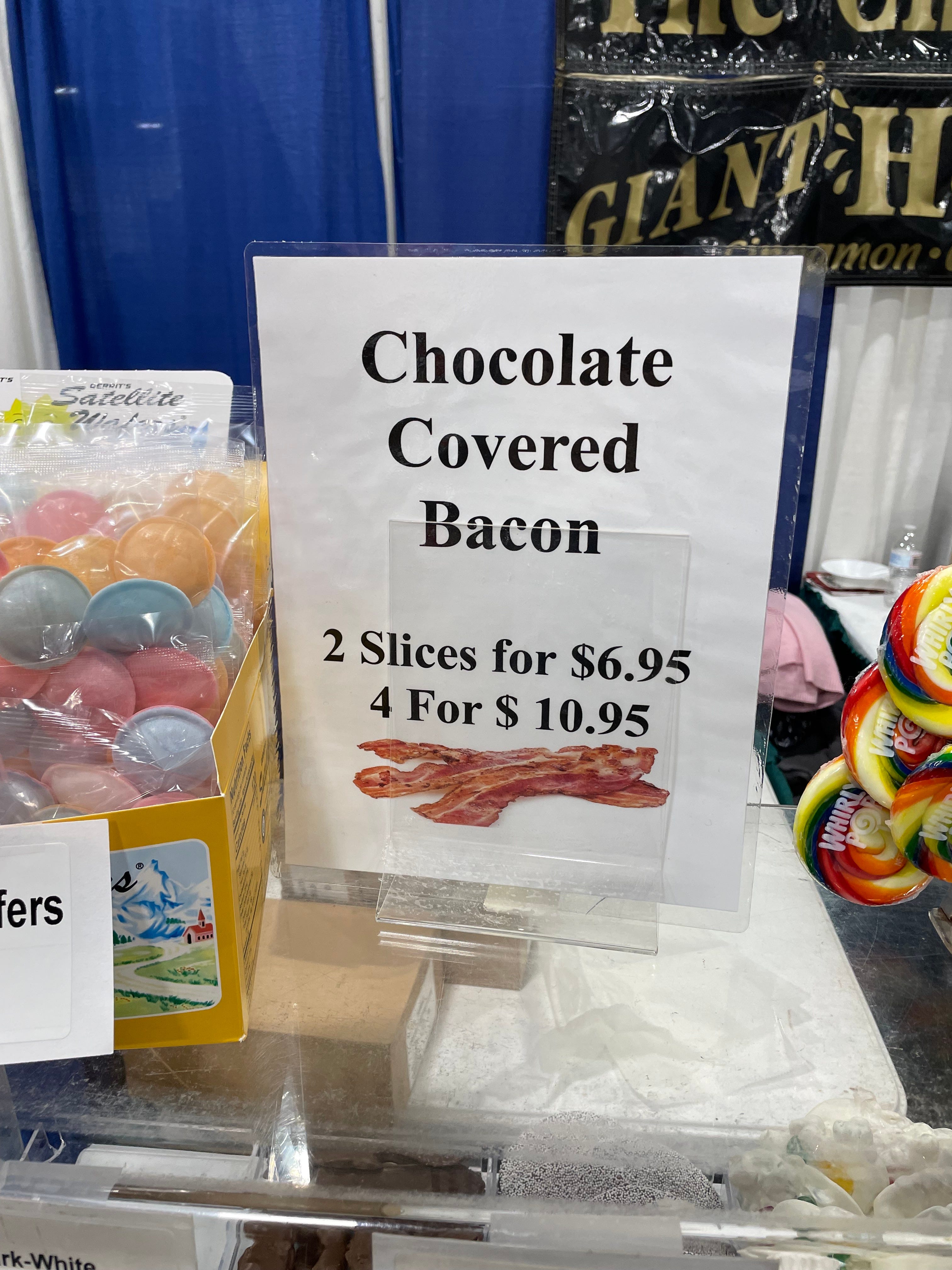
The munchies alone will take years off your life expectancy, and as John Gierach said, death can really cut into a guy’s fishing time.
It’s not just the jerky, which is typically made from bottom round, a lean cut taken from a steer’s rump. There’s the Cheese Filled Company, peddling pepperoni and pickles packed with pepper jack, cheddar, and muenster. One outfit is selling elk, bison, and venison sausages; others are hawking “fresh heavy cream fudge” and chocolate-covered bacon, which looks to me like a heart attack on a stick.
One of the advantages of a fishing show, of course, is that you can talk with dozens of guides and charter captains under one roof and leave with a fistful of brochures if you’re planning an adventure away from your home water, which is convenient. But even these guys can cave to the spirit of shameless self-promotion that’s in the air.
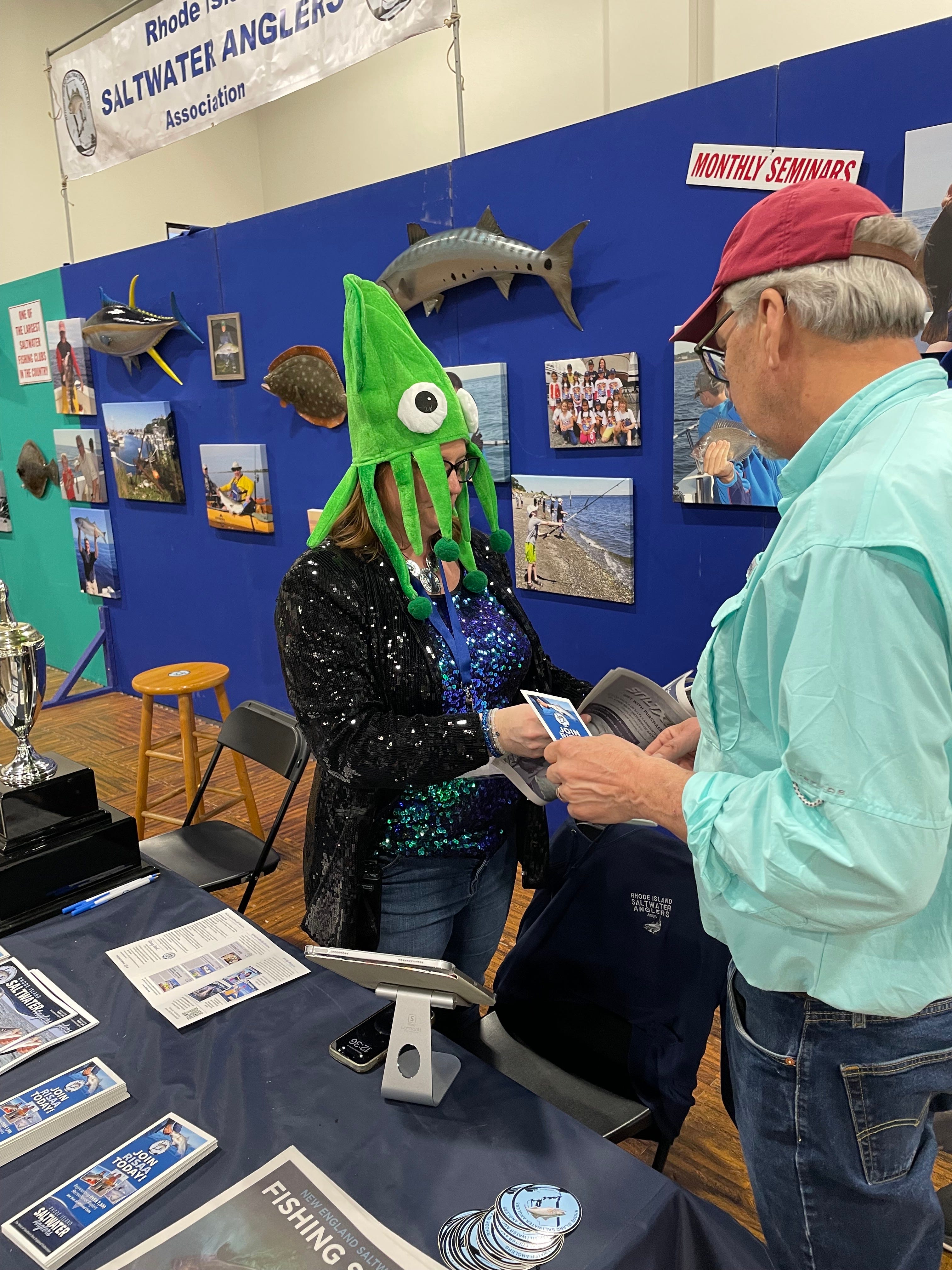
In the Northeast, you’ll find outfitters calling themselves corny names like Tunacious or Striper Maine-iacs, and there always seems to be a Big Al. At the Rhode Island show, a charter captain who styles himself as the Skurge of the Sea is selling “bass bomb” lures a couple of rows over from a woman wearing a tentacled squid hat and a man in a headset perched atop a narrow two-story fish tank, demonstrating a lure that’s twitching almost as seductively as those bass boat models.
Way in the corner in the last aisle, almost as an afterthought, a couple of fly fishermen are selling flies, rooster necks and rods. Saltwater being the theme here in the Ocean State, they’re doing a brisk business with tried-and-true patterns like the Lefty’s Deceiver, Clouser Minnow and Surf Candy. Those are my go-tos as well, but I’m always especially intrigued by the nondescript patterns that locals swear by, and a surprising number are done up in hot pink, day-glo orange, chartreuse, and other colors not found in nature.
Many are the creations of New England fly fishing shaman Joe Calcavecchia, a jovial master commercial tier who sports a salt-and-pepper goatee and suspenders decorated with dry and wet patterns. He’s the inventor of something called the Mojo Squid — a five-inch sparkly pink and white streamer with startlingly realistic blue eyes. Joe’s flies are like those dusty portraits of long-dead aristocrats in horror films whose eyes follow you around the room: lifelike, sure, but freaky as fuck. You fish them on an intermediate line with an erratic stripping retrieve as though they were aquatic zombies, which in a way they are. They’re great with striped bass and bluefish, though I’ve always suspected the strikes they draw are motivated more by terror than hunger.
Anyway, you’d think that taking in all of that would be enough of a draw for any given fishing show, but apparently not, because the capitalistic need to boost attendance has produced some weird marketing mashups. In the South, there’s the Virginia Fly Fishing & Wine Festival, which is just like it sounds: Fly anglers pore over tackle, listen to lectures and practice their casting skills, then trade tippets for a little tipsiness at tastings offered by a dozen local wineries and distilleries. Fly fishing can never seem to shed its elitist reputation, and I guess I always flinch a little when I come across the highbrow elements of our sport. As an angler I encountered a few years ago put it: “I really miss when fly fishing was the realm of dorks, alcoholics, nerds, old men, and other assorted losers.”
From what I can see, we distill into distorted funhouse mirror reflections of ourselves at a fishing show. (I once toured a fly fishing expo in Michigan where I heard something I’ve never heard uttered on a trout stream and frankly hope I never will: “Honey, do these waders make my ass look big?”)
And what we are, above all else, are crass consumers. Fishing shows tap into those baser instincts: a primal need for stuff. It probably began in the Paleolithic Era when one of us looked with envy at a rival’s club and then at our own, which was entirely serviceable but not quite as nice. This is how things like custom cork grips, silk wraps, and reels with smooth disc drags get to be a thing.
A few years back, outdoor columnist Terry Drinkwine — who if nothing else has the best byline in the business — perfectly captured the ethos of the modern fly fishing expo: “One thing that comes out of attending a show is the realization that you probably don’t own everything there is relating to fly fishing or fly tying.” Drinkwine says he’s been trying to disabuse himself of the notion that he needs more rods or flies or gadgets or whatever and that his wife, “She Who Must Be Obeyed,” sometimes shadows him to make damned sure he doesn’t cave and return home with yet another rod tube.
Incidentally, the world’s largest general interest fishing show is ICAST, held in midsummer in — where else for what has become an angling Disney World? — Orlando, Florida. The word on the street is that attendance is shrinking, and the booth with the cheap knockoff Chinese-made lures may be hurting more than it’s helping. But with well over ten thousand people wandering the hall, and with an entire wing devoted solely to a “Fly Fishing Village” populated by expert tiers and a casting pool, it’s likely got some staying power.
This is probably the main reason why I’m conflicted about shows. I’m as easily enticed as anyone when it comes to fishing essentials and nonessentials, so a good expo will always give me a rush. But for the same reasons that I’m hoping the books you read are copies you either borrowed from a public library or bought at an independent bookstore, I’d rather spend my hard-earned money at my local fly shop. It’s the least I can do in exchange for the camaraderie, the free advice, the updated hatch and water flow charts, and the occasional hot tip.
___
ONE OF the premier fly fishing shows in the country calls itself, somewhat unimaginatively, just that: The Fly Fishing Show. It’s a staple of winter, when only the most diehard of us venture out on the water, and tours more than half a dozen states, operating on the theory that if a little of something is good, a lot is better.
That explains why you’ll have your pick of workshops run by nearly two dozen top fly tiers, and a chance to try out rods by virtually every manufacturer in the U.S. In your peripheral vision, you’ll see some of the biggest names in fly angling. Is that Bob Clouser darting like one of his eponymous minnows through the crowd? Probably.
Flylab’s Kirk Deeter, reviewing the show’s Denver stop, wasn’t impressed by the inflated pricetags on rods or by some of the big manufacturers who’ve pretty clearly strayed from their founding principles to put fishermen first. But he’s noticed a hopeful trend: more young families wandering the aisles. “I’d always remembered fly-fishing events to be seas of white hair under baseball caps,” he writes. “I saw more strollers than walkers this time out, which bodes well for the sport’s future.”
A cool, to me anyway, fringe benefit is the International Fly Fishing Film Festival, which follows the same schedule as The Fly Fishing Show. The IF4, as it’s known, screens the world’s most visually sumptuous fly-fishing films, and let me just say that cinematographers love Colorado’s cutthroats and Labrador’s brookies. Now this is trout porn. You’ll also occasionally be treated to a more transcendent film like Joshua Caldwell’s Legacy, which follows the first couple of American fly fishing, Barry and Cathy Beck, and Barry’s quest for healing after her death. I’m not crying; you’re crying.
If The Fly Fishing Show is the gold standard, let’s just say there are a few out there made of bronze, if not tin.
Dave Grossman of the slightly gonzo but always entertaining online fly fishing magazine Gink & Gasoline talks about how many expos are now cluttered with booths hawking gutters, garage doors, and replacement windows. I’ve noticed this trend at other sporting expositions, including one run by the venerable Boston Marathon, which should know better. Dave’s unambiguous plea: “Leave. You are the butt of all our jokes. You stick out like a sore thumb and we in the fly fishing world are not the weak-minded prey you seek. I heard there was a golf show just down the street. Peddle your wares there.”
Dave is also righteously indignant at people who grab fistfuls of stickers, which he notes may or may not be free: “Sometimes vendors put out stickers as freebies. In this case, grab one or two. Grabbing twenty-five makes you look like a greedy asshole. Nobody liked that kid at Halloween and the same still holds true.” And Dave calls out other fishing show misbehavior — patrons who drink early and often. You’ll often find delicious craft beer on offer at an expo, and I’m all for that, but a.m. bingeing isn’t a good look. “While I fully embrace the alcohol component of the New World fly fishing show, it is a little gauche to be hammering them down when the doors open on Sunday. Noon is a minimum here, lest we go all Lord of the Flies,” he writes in a commentary for Gink & Gasoline that’s appropriately headlined: “Something’s Fishy at the Fly Fishing Show.”
Whimsy, though, is what keeps me coming back to any given expo. At one show, there was a rack of brook trout hoodies complete with white edging and neon spots apparently intended to transform Homo sapiens into Salvelinus fontinalis. Apart from the sheer kitsch, they seemed vaguely dangerous — akin to a deer hunter dressing as an eight-point buck and venturing into the woods during whitetail season.
Humor is baked into the oddball niche interests you’ll occasionally encounter at a show. Kentucky’s annual Catfish and Crappie Conference — known to many as CatCon or, hilariously, CrapCon — epitomizes what I’m talking about. Every winter, catfish enthusiasts gather in Louisville to talk tackle and tactics at a trade show where catfish specialists are front and center and organizers hand out something called the Golden Whisker Awards.
There used to be another in Tennessee called Catapalooza but, like the slimy horned beasts it promoted, it’s since gone under. As YouTube fishing podcaster Dieter Melhorn notes with no irony, the catfish community is relatively small. Even the Catfish Conference, which got its start in the parking lot of a boat dealership, tried to add a show but made the fatal mistake of staging the attempt during deer season. “Bad idea,” Melhorn says.
It’s flourishing, though, and has become what he calls “kind of a Mecca, a pilgrimage for the catfish world.” At least one attendee, Chad Herfel, would quarrel with that endorsement — he describes the 2025 edition as “a tedious slog through what amounted to nothing more than a glorified flea market.”
Perhaps unsurprisingly, fly fishermen are a minority in the catfish community, though you can catch the bottom dwellers with sinking lines and weighted flies. I’ve only ever managed it by accident, and I can’t say I enjoyed the experience. You haven’t known pain until you’ve been stuck under a fingernail by a catfish’s bony dorsal or pectoral spines. I’d sooner reckon with a toothy pickerel than a big cat.
Anyway, flies clearly pale in comparison to the baits used to tempt a trophy catfish — rancid shad guts or raw chicken cured for twenty-four hours in a mixture of cherry Jell-O and garlic. I’m told that catfish are delicious, which is curious, given the garbage they’ll happily forage.
That got me to wondering whether I’ve been misunderstanding the ubiquity of beef jerky at fishing shows. Maybe it’s being sold more as bait than for human consumption? A quick Google search suggests I’m on to something — there’s an entire Reddit thread devoted to monster catfish and carp caught with cured meats.
Ever the fly guy, I’ve been thinking about inventing and experimenting with a jerky pattern; probably a bucktail but maybe a weighted sculpin. I’d call it the Slim Jim and fish it on a dead drift. You know, to imitate the naturals.
___
BACK TO those muscular boats at the saltwater show in Providence. They’ve always tempted me, if only because my own watercraft have necessarily been so humble.
These days, when not wading, I rely on a combination of a kayak that, in spite of its raised ergonomic seat, plays havoc with my lower back when I’m fly casting while bent in half, and an ugly plastic contraption known as a Pond Prowler that’s powered with a ten-horsepower MinnKota electric motor and a battery so heavy I’m always surprised it doesn’t point the bow of the boat into the air and capsize me.
My brother Rich’s kayak has everything but flying buttresses. He’s added pedals, a rudder, and a motor with foot controls, and it’s bristling with flags and rod holders. I tease him that he should launch a new business — Pimp My ‘Yak — but he’s just living his truth out on the water, and that can never be a bad thing, right? Also, those pedals are gold: They let him hover in one place to cast repeatedly to a difficult fish, while I have to keep stabbing the water with a paddle between attempts as the wind blows me too far from — or worse, too close to — my target.
This is one of those rare instances where spending a little or maybe a lot more money on gear really does make a difference. Rich is a spin fisherman, and I’d always fished circles around him with a fly rod. Now he outfishes me with some regularity, which is annoying.
My father’s boats were always named Onrush — the wartime code name for the USS New Jersey, the battleship upon which he served as an engineer during the Korean conflict. In his honor, my little Sunfish sailboat is now registered as Onrush III, ostentatious in the finest tradition of over-the-top absurdity. Lately I’ve taken to naming my equally diminutive fishing craft Bass Ackwards — a playful twist on Ass Backwards, and a name entirely in keeping with the mirth I’ve always encountered on New England’s ample waters.
Watercraft, like wine bottles, are perfect tableaux for clever turns of phrase. Somewhere on Massachusetts’ Buzzards Bay off Cuttyhunk Island, while fly casting for stripers, I once heard a boat identify itself on the radio as the Wet Dream.
From now until the end of time, all other nautical names will be measured against the sublime irreverence of that one.