Shit’s Creek
Is it still fishing even though you’re not catching?

THIS IS an epic fish story. All that’s missing are the fish. It’s a reverse Moby-Dick, if you will.
Call me Fishmael.
But let’s face it: We all have those days when absolutely everything that could go wrong does — a clusterfuck that not even Edward Aloysius Murphy Jr. and his detestable law could quantify.
I’ll never forget a particular day on the gin-clear Squannacook River, one of the finest trout streams in my native Massachusetts, when everything pretty much methodically went to hell during an otherwise sublime caddis hatch. I liken the Squannacook to a gin and tonic, but really it’s more like a Manhattan, tea-stained from peat moss and leaves shed by the oaks that line its banks. Rivers like this easily can deceive a wading angler: You step into what you’d swear is no more than two feet of water and wind up in over your hat.
First, I lost my fly box. Suddenly confined to the smattering of patterns stuck in the patch of lamb’s wool on my vest, I lost my nerve. Then I lost a big fish — a wild holdover brookie — and very nearly lost my mind. But St. Andrew, the patron saint of fishing, wasn’t finished with me yet: As I cut my losses and was de-rigging in the parking lot, I broke off the tip of a new Orvis five-weight in the car door.
There’s nothing like a stream to reveal flaws and shortcomings, and sooner or later, most of us will come face to face with our weaknesses in our pursuit of trout. “A bad day of fishing is better than a good day at work” has become a bumper sticker cliché, but as one wag wryly observes: “A bad day of fishing sucks. If I had known beforehand the fishing was going to suck, I'd have chosen to work overtime.”
___
I HAD one of those frenetic, fishless days — an entire week’s worth of them, actually — in Croatia, where I set out to fish the Adriatic for mahi mahi, a chunky species more typically associated with the tropics. In the Hawaiian Islands, they’re prized for the table, and their recent appearance in southern Europe isn’t good news; it’s a consequence of rising sea temperatures as climate change remakes the angling map. But they’re garishly yellow and blue-green, weirdly blockheaded, grow to massive proportions, and you can get them with a fly rod. Since they’re an invasive species, I was able to suspend my normally militant catch-and-release mindset and try for a couple as ingredients for fish tacos (and, as a bonus, to impress Masha, my Croatian-born partner.) Win-win.
Naturally, the universe punished me for my hubris. I should have seen lose-lose coming from a kilometer away.
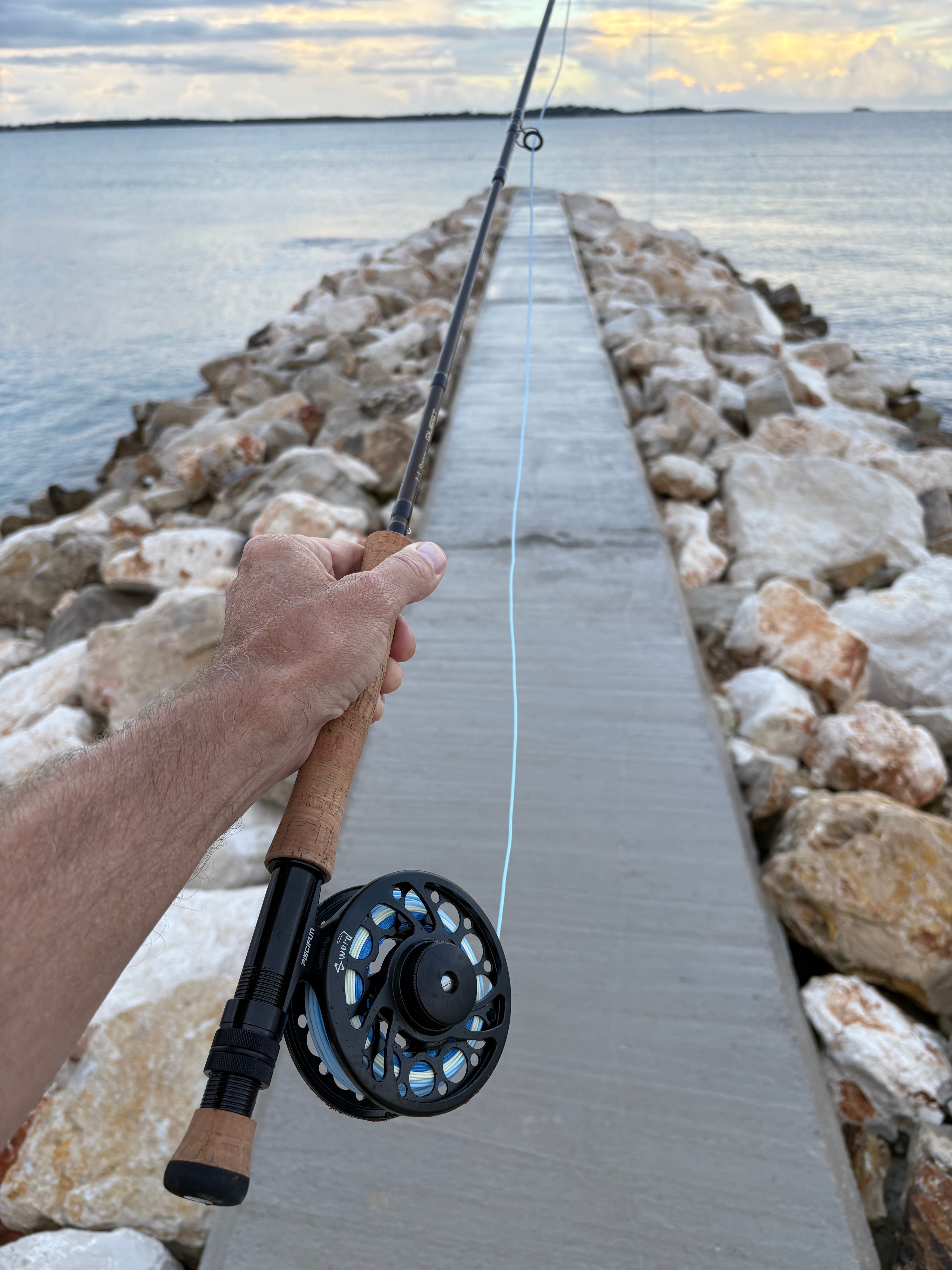
Mere minutes into my first outing in the coastal Istrian village of Peroj, my $200 prescription eyeglasses tumbled irretrievably into the sea as I was false casting a Surf Candy streamer while balanced precariously on slippery boulders at the tip of a jetty. It was a fitting metaphor: I was fishing blind anyway.
As it turned out, I was even more clueless. The man behind the counter at a tackle shop just up the rocky shoreline in the ancient city of Rovinj told me that mahi mahi don’t show up until the end of August. I was there fully a month too early.
Okay, but the best time to go fishing is when you have time to go fishing (more bumper sticker wisdom), and the guy had dozens of Polaroid snapshots of himself or others hoisting 40-pound-plus bluefish, so I asked him about places and tactics for blues. He was generous with information, even though I hadn’t bought anything — decidedly uncool on my part; you should always buy a fly, a spool of tippet, something, anything — and told me to focus on shallow water with a current. I interrupted him to suggest shallows with sudden drop-offs — places I’d come to know Stateside as sweet spots where larger fish often hold and ambush prey — but the guy shook his head adamantly and a little impatiently. No. Shallow water with some kind of current. So that’s what I sought out.
Here and there along the winding, pebbly beached coastline of what was once a prized part of the former Yugoslavia before its breakup in the 1990s, you’ll find squat concrete bunkers with narrow slitted windows dating to World War II and the Cold War. I’d asked Masha about them:
“Are those root cellars?”
“No, you idiot, they’re sniper nests.”
In the salt, if you’re not in a boat, preferably one with a motor, you’re at a distinct disadvantage. A watercraft speeds you to hotspots where birds are crashing into the surf, targeting large balls of minnows that are bunching up, strength in numbers style, in a panic to escape the predators just below. If you’re fishing from shore or wading the surf, you can target rockpiles, jetties, and other visible structure, but all that birdy, fishy action is hopelessly out of reach.
Still, I felt pretty good about my chances; if not for mahi mahi or bluefish, then at least for bream or mackerel or mullet or sea bass. Water is water, and I grew up fishing the coastlines of Massachusetts and Rhode Island. Plus, I was well-equipped with a new LL Bean four-piece 9-weight; a serviceable aluminum alloy reel rigged with plenty of backing and a floating line with a shooting head; and a decent selection of my go-to flies: weighted Clouser minnows, Lefty’s Deceivers, and Surf Candies. How hard could this be?
Goddamned hard, as it turns out. For the catch-and-release angler, setting out to kill a fish for the table is a fraught business. It is at once disorienting, a little unsettling, and nowhere near as easy as it should be. The LL Bean cast like butter, and the shooting head got my fly well out into the rip current, where I’d retrieve it by stripping it as seductively as I could imagine. But the fish? Conspicuously absent.
I ventured out before sunrise to beat the baitcasters to the best spots, once forgetting my flies in the car only after hiking out to the tip of a long jetty, clambering over seaweed-slicked boulders the size of Smart Cars and skinning my knees. On another outing, I forgot my hat, so naturally on one forward cast I whacked myself badly in the back of my head with the business end of a lead barbell-eyed streamer, momentarily seeing stars but narrowly avoiding a nasty self-hooking. I overdressed one sweltering afternoon and underdressed the next morning, nearly suffering hypothermia as I stood waist-deep in seawater chilled by an overnight thunderstorm.
In a fit of determination and self-delusion, I kept flogging the Adriatic, but in the end, the Adriatic flogged me. It’s a truism that any given fishery will produce for the angler who puts in the time, but for all of my effort, I was rewarded with precisely nothing. Not even a shad or a herring. Come to think of it, I never even had a take. It was, indisputably, the most royal skunking/slash/spanking I’ve had in a decade.
On one break from the exasperation of complete and utter fishlessness, we drove our rental car to nearby Vodnjan, where the Church of Saint Blaise holds the remains of four perfectly preserved medieval mummies of holy men and women who lived between the 1100s and 1400s. But even then, all I could think of was the fish that were eluding me. One of the saintly stiffs was gripping a staff that looked to me like a 10-weight spey rod. I bet God wouldn’t have denied that dude a fish, I remember thinking.
On another break, we took a ferry to Brijuni, a hilly island where the authoritarian Yugoslav leader Josip Broz Tito entertained Fidel Castro, Ho Chi Minh, Queen Elizabeth II, and hundreds of other foreign dignitaries. We pedaled in the shade of pine trees past Roman ruins and paddocks holding the camels, zebras, ostriches and other exotic animals that Tito was gifted during his reign. I hopped off my rented bike for a closer look at Lanka, an elephant that Indian Prime Minister Indira Gandhi presented to the Croatian-born strongman.
Now in her mid-50s and a little long in the tusks, Lanka had lost the love of her life, a bull elephant called Sony. She met my gaze and shot me a look that was laced with an air of resignation, as if to say: No, it’s not your imagination — life in general, and the fishing in particular, really was better back in the day.
Almost on cue, I was wandering Brijuni’s National Park Museum when I heard from Dusan, an old friend and fellow journalist in neighboring Serbia. I’d posted a snapshot with the caption, “Fly fishing the Adriatic. Not catching yet; just fishing,” to which Dusan responded: “No fish in the Adriatic, dear Bill … but good for relaxation.” I read this as I stood before a large sepia-toned photograph of Tito on a boat dock, hoisting an enormous conger eel that easily would have gone six feet long and 50 pounds. “That’s not what Tito tells me,” I retorted. But seriously, what the hell? At open-air restaurants up and down the Istrian coast, we’d been dining on fresh fish every evening. Why couldn’t I catch one?
Before we boarded the ferry back to the mainland, Masha, determined to prove me wrong, led me by the hand to a corner of Brijuni’s port where she promised me we’d see pods of silvery dorade, a dinner plate-sized species of bream that pairs nicely with Croatia’s signature Malvazija white wine. We shaded our eyes and peered intently into the water. You probably guessed it: Zilch, nada, nichts, rien de tout.
As the writer David Coggins notes wryly: “Sometimes it’s just not happening and you have to admit you’re licked.”
In a final indignity, security at Zagreb’s airport refused to let me hand-carry my fly rod back to Paris. I’d been allowed to board the flight to Croatia with the rod tube as my carry-on, but the self-important screener made me return to the check-in counter, where an airline representative informed me I’d have to fork over $75 to have the rod handled as a second checked bag — even though it weighed less than two pounds. Eventually, the charge was waived, but because the tube was deemed too small to make it to the plane on those automated belts, I was sent to the “oversized luggage counter” with my undersized item for special handling: surely airlinespeak for kiss your rod goodbye.
I was certain I’d never see the rod again. Against all odds, the very first item to pop out on the belt at baggage claim in Paris was my rod case. I unzipped it and peeked inside, naturally, to make sure the rod and reel were still inside. They were. Oh, me of little faith.
But then something similar happened again at John F. Kennedy International Airport in New York as I winged my way back to Boston. A screener stopped me because my rod tube looked suspicious. It all begged the question: If not even the fish were terrorized by my rod, what possible menace could it pose to the security of the homeland?
___
A KAYAK, like a man at midlife, is inherently unstable.
Back in New England, I was nearly crazed by the visceral need to feel the heft of a fish, any fish, at the end of my line. Perch, carp, bluegill — at this point, the species was immaterial.
Rich and I were floating the lake, sipping beers and picking up the occasional bass or pickerel, when I zigged when I should have zagged and capsized my kayak, sending a $300 battery and $700 nearly new Minn Kota electric trolling motor to the bottom. We spent half an hour trying to locate them, but it was hopeless: We’d been hovering over the deepest part of the reservoir when the kayak overturned. I even lost my favorite cap, which pissed me off — shouldn’t hats float, for Chrissake? And I felt terribly that my lead-acid marine battery now lay on the muddy bottom, where it’d slowly leach toxic heavy metals into the environment.
In a lifetime of fishing, you’re bound to inflict a little damage on the natural world. But my father raised us to leave any given lake or stream cleaner than we’d found it, and I’d always thought that anglers should swear a sportsperson’s version of the Hippocratic oath: Primum non nocere; above all, do no harm. Trust me: Jettisoning a battery in your favorite fishery feels a little like pissing in your own pool. Dad would have disapproved of both.
It could have been worse. At least my iPhone, car keys, and most importantly, my rod didn’t wind up in the knee-deep muck at the bottom of the reservoir.
And I was able to keep fishing and get back to shore at day’s end because I still had my paddle. In more than half a century of angling, I’ve learned the hard way: You don’t want to find yourself up Shit’s Creek without one of those.